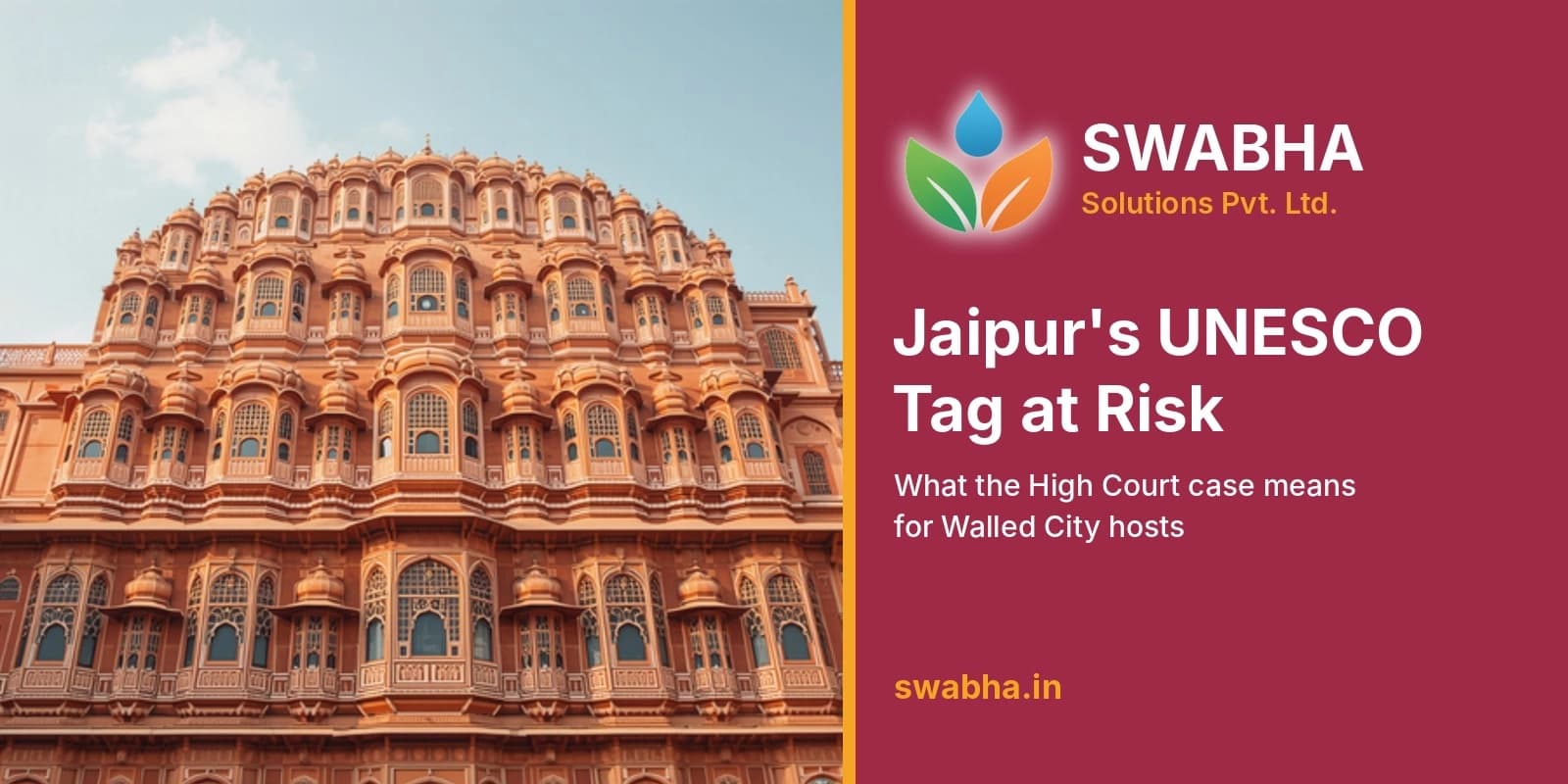
The pink walls are the reason many guests book Jaipur. They are also, right now, the subject of a court case.
On 26 September, Justice Pramil Kumar Mathur of the Rajasthan High Court took suo motu notice of a Rajasthan Patrika report on the "alarming degradation" of Jaipur's Walled City. The court warned that the city could lose its UNESCO World Heritage status if effective remedial measures are not taken before December 2026 (LawBeat). A division bench of Chief Justice Sanjay K. Agrawal and Justice Sameer Jain has since registered it as a public interest litigation, In Re: Global Identity of the Pink City, and listed it for hearing in the week starting 26 October, which is this week (LiveLaw).
For anyone who runs an Airbnb, homestay or guest house in or near the old city, this is not just a heritage story. It is a business story. Here is what is happening, what could change and what hosts can do now.
What the Court and UNESCO Have Asked For
Jaipur's Walled City was added to the UNESCO World Heritage List in 2019. UNESCO's World Heritage Committee raised concerns in 2023 and again in 2025. Its 2025 decision (47 COM 7B.71) flagged reports of demolished historic houses, the limited capacity of the city's Heritage Cell, and projects, including the Jaipur Metro, that moved ahead before heritage impact assessments were finished. India must send an updated conservation report by 1 December 2026 (UNESCO).
The High Court has ordered the Jaipur Development Authority (JDA) and the municipal corporations to:
- Survey unauthorised and unregulated construction in the Walled City.
- Report five years of illegal construction and what action was taken, such as sealing, demolition, prosecution or penalties.
- Explain how height limits, buffer zones and architectural controls are enforced.
- Submit a phased action plan to stop further damage.
Notices went to 10 state and local authorities, and the court asked them to show why officials should not face action (Law Trend, LawBeat). The judges were blunt: the designation "is not merely honorary," and losing it would be "an irreversible loss of cultural and historical wealth" (LiveLaw).
How Bad Is It?
The numbers are worrying. When Jaipur won the UNESCO tag, about 1,200 historic havelis stood in the old city. Jaipur Mayor Sunil Kothari now says about a third of them have been lost to demolition and decay (ETV Bharat, 17 October 2026). Old homes are being turned into shops and offices, and some buildings now hold dozens of businesses. Market verandas are blocked by sheds, walls and restaurant seating.
"Commercial pressure is encouraging violations and the conversion of old homes into larger business premises," says Damodar Sharma, a former IAS officer who twice headed the municipal corporation. Former additional chief town planner Chandrashekhar Parashar puts it simply: "Rules on paper alone cannot save heritage."
The risk is real but not instant. If UNESCO is not satisfied, the usual next steps are a monitoring mission or a place on the "List of World Heritage in Danger," not automatic removal (Outlook Traveller). Still, the court has noted that sites have been removed from the list before.
Why This Matters to Jaipur Hosts
Heritage is the product. In the first half of 2026, Rajasthan recorded 10.92 crore tourist visits. Jaipur alone drew 81.49 lakh domestic visits and about 2.56 lakh foreign visits, roughly 30% of all foreign visits to the state (Travel Trade Journal, citing Rajasthan Tourism data). Foreign guests in particular plan trips around the UNESCO list, and Hawa Mahal, Jantar Mantar and the bazaars of the old city are what they come to see.
The short-stay market is already competitive. According to AirDNA (updated 20 October 2026, data to September), Jaipur has 3,244 active short-term rental listings, down 20.7% from a year ago. Occupancy is 37% and the average nightly rate is about $38 (roughly ₹3,300), down 21%. Hosts are earning more by filling more nights, not by charging more. A damaged heritage image would make that harder, especially for homes that sell themselves on "stay in the Pink City."
There is also a nearer risk. A court-ordered survey and tougher enforcement may lead to sealing, notices or demolition of unauthorised floors and alterations. In the Walled City, the rules allow about ground plus three floors (around 15 metres) on main market roads and ground plus two (around 12 metres) on narrow inner streets (ETV Bharat). Extra rooftop rooms, glass extensions and changed façades are exactly what surveyors will look for. A sealed building means cancelled bookings, refunds and a hit to your reviews.
The good news: the rules do allow sensible reuse. Parashar notes that under set conditions, Grade-II and Grade-III heritage buildings can be used for heritage accommodation, guest houses, galleries and cultural centres. In other words, a well-run, properly approved heritage homestay is part of the solution, not the problem.
Your 6-Step Plan If You Host in or Near the Walled City
- Check your paperwork now. Keep your building approvals, ownership papers and any heritage permissions in one folder. If you added a floor or a rooftop room, find out whether it was approved before the survey team arrives.
- Pause big renovations. Do not break walls, add floors or change the façade without written permission. The heritage regulations need prior approval for many restoration jobs, and verandas and their terraces must stay clear.
- Register your stay. If you run a homestay, register it under the Rajasthan Homestay Scheme 2026 and keep guest records, including Form C for foreign guests. Registered, compliant hosts are on safer ground when enforcement tightens.
- Keep the heritage, keep it clean. Original jharokhas, lime plaster, wooden doors and stone floors are what guests photograph. Clean them gently: no acid cleaners on stone, no harsh scrubbing on lime walls, and regular dusting of carved wood and jaalis.
- Be a good neighbour. Do not block the veranda with seating, scooters or luggage, and manage guest noise and trash in narrow lanes. Complaints draw attention.
- Tell the story. Add a short note in your listing and welcome book about the Walled City's UNESCO status and how guests can respect it. Guests who feel part of the heritage tend to treat your home better and leave warmer reviews.
Protecting the Pink City, One Stay at a Time
Jaipur's World Heritage tag took decades to earn and could be put at risk in months. The government and courts must do the heavy lifting, but hosts have a part to play too. Every well-kept haveli, every clear veranda and every respectful guest makes the case that the old city is alive and cared for.
At Swabha, we help Jaipur hosts run spotless, guest-ready homes with turnover cleaning, linen management and restocking. Our trained team knows how to care for heritage homes, from stone floors to carved wood, without damaging them, and we share photo records after every clean.
Run a heritage stay in the Walled City? Let Swabha keep it guest-ready. Message us on WhatsApp at +91-96490-96964 or email info@swabha.in.
Also read: Jaipur Airport's winter schedule and what it means for hosts.
This article is general information, not legal advice. Court orders and rules may change after hearings; check with the JDA, the municipal corporation or a qualified professional before any construction work. Rupee figures are approximate conversions at about ₹88 to the US dollar.
Sources: LawBeat on the High Court's suo motu order, 29 Sep 2026; LiveLaw on the PIL and hearing date, 9 Oct 2026; Law Trend, 1 Oct 2026; Outlook India, 1 Oct 2026; UNESCO World Heritage Committee decision 47 COM 7B.71 (2025); ETV Bharat, "Marked Unsafe" part 2, 17 Oct 2026; Outlook Traveller, 3 Mar 2026; Travel Trade Journal on Rajasthan H1 2026 tourist visits, 28 Aug 2026; AirDNA Jaipur market overview, updated 20 Oct 2026.